One core, every language
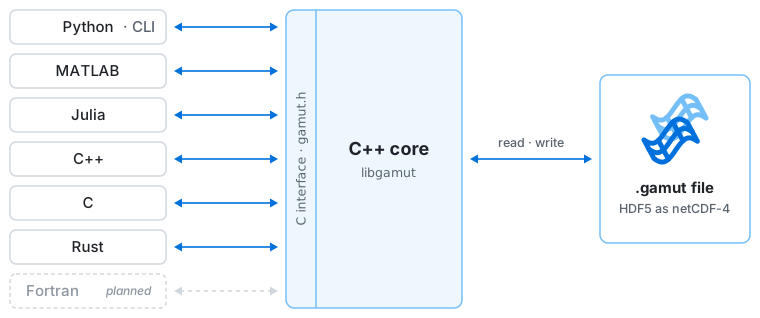
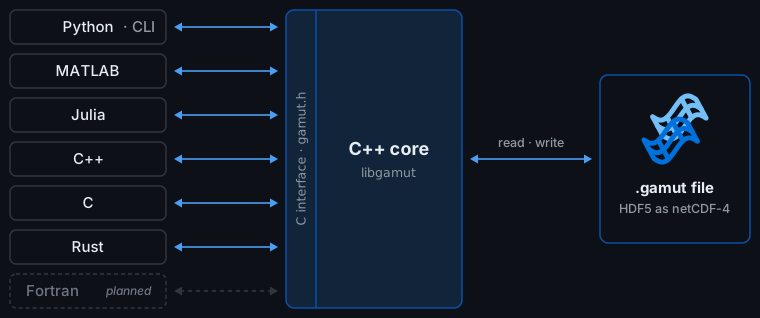
Every language reads and writes through the same library: a core written
in C++ that implements the format, writing, reading, selecting rows,
validating and the built-in model, behind a C interface,
gamut.h,
which is all the library exports. Each language is a thin layer over that
interface, C++ included:
| Language | Reaches the core through | Installed as |
|---|---|---|
| Python | ctypes |
the bijective-gamut wheel, core included |
| MATLAB | a MEX gateway | the Gamut.mltbx toolbox, core included |
| Julia | ccall |
the package, pointed at a release's core or the wheel's |
| C++ | gamut.hpp, a header over gamut.h |
the core built with CMake |
| C | gamut.h |
the core built with CMake |
| Rust | the bijective-gamut crate over bijective-gamut-sys, the declarations of gamut.h |
the crates, linked to a release's core |
| Command line | the Python package | gamut and gamut-vtk, installed with the wheel |
What that means
A file written in one language is read the same in every other, value for
value, because one library reads it. A refusal is the same everywhere: the
core decides it, and every language reports the rule it names (E7 for
units that do not parse), as GamutError.rule in Python and Julia, the
error identifier gamut:E7 in MATLAB, gamut::Error::rule() in C++ and
Rust, and the gamut_error filled by every C call. A condition passed to select
means the same in every language, and the built-in model gives the same
answers to the last bit.
The packages carry the core with HDF5 linked inside it, so it never meets another copy of HDF5 in the same process: h5py's, MATLAB's or a solver's.
What differs
Each language spells the calls its own way, and counts positions its own way: from 0 in Python, C++, C and Rust, from 1 in MATLAB and Julia. The codes stored for a label or mesh label count from 0 in every language, since they are part of the file. The reference gives each language's spelling of the same calls.
Some conveniences live in one language. Python converts units on reads
and writes (through pint), takes and gives pandas tables, imports and
exports VTK, and provides the gamut command line. Model types of your
own are registered in Python or MATLAB; Julia, C++, C and Rust evaluate
the built-in model.