Benchmarks
Gamut combines compressed array storage with a defined simulation study: inputs, meshes, results, units and run relationships, accessed through the same study vocabulary in Python, MATLAB, Julia, C++ and C. These benchmarks measure the storage and read costs of that choice. The comparison explains each format's purpose and interoperability; timings alone do not measure clarity or language support.
HDF5 and netCDF-4 are Gamut's foundations. A matched h5py baseline below reads the same Gamut file, with identical arrays, chunks and filters. It measures direct storage access beside the study interface. The older "HDF5, a group per run" result measures one custom layout, not HDF5's limits.
Native simulation formats — 20 October 2026
Exodus II and CGNS are measured through their native C libraries, called
from Python. PhysicsNeMo-Mesh uses NVIDIA's official Mesh.save and
Mesh.load on CPU. These are measurements of the stated layouts, libraries
and settings, rather than an intrinsic ranking of format names.
A geometry family
The capsule study has 1,364 runs on 44 geometries sharing one topology: 6,722 nodes and 6,720 quadrilaterals, with pressure and heating from engineering methods. It is not CFD validation. Each native result file holds one geometry and all 31 of its runs, avoiding a file per run.
| Format | Size | Write | One run | One node, every run | A region, every run | Runs by condition |
|---|---|---|---|---|---|---|
| Gamut | 66 MB | 1.39 s | 1.86 ms | 121 ms | 133 ms | 1.87 ms |
| Gamut, 4 threads | 66 MB | — | 1.92 ms | 25.2 ms | 26.6 ms | 2.02 ms |
| Exodus II, native defaults | 160 MB | 327 ms | 6.06 ms | 73.1 ms | 113 ms | 4.44 ms |
| Exodus II, gzip 1 + shuffle | 67.9 MB | 1.19 s | 5.74 ms | 183 ms | 225 ms | 4.35 ms |
| CGNS, native defaults | 167 MB | 485 ms | 22.7 ms | 836 ms | 844 ms | 4.16 ms |
| Storage baseline: same file via h5py | 66 MB | — | 492 µs | 126 ms | 138 ms | 310 µs |
Gamut and compressed Exodus occupy about the same space. Gamut reads a whole run and queries this run table faster in these implementations. A node across every run is expensive for Gamut's default chunks; the four thread read reduces that cost. The matched h5py row makes both the fixed interface cost on small reads and similar bulk decoding cost visible. PhysicsNeMo-Mesh cannot natively represent this quadrilateral mesh: its mesh model requires simplices. Gamut, Exodus and CGNS preserve the quads. The separate conversion case below measures PMSH after triangulating the input for every peer; the original quad results above remain unchanged.
The capsule with triangulated connectivity
This is a separate storage/read case. Each original quad [a,b,c,d] is
split into [a,b,c] and [a,c,d], in source-cell order, giving 13,440
triangles. All 6,722 nodes, 44 geometries, 1,364 runs, nodal values and run
table entries are retained without interpolation. Every peer is rewritten
and timed on that same transformed input, including Gamut; no row below
is borrowed from the original quad measurements.
| Format | Size | Write | One run | One node, every run | A region, every run | Runs by condition |
|---|---|---|---|---|---|---|
| Gamut | 66.1 MB | 1.42 s | 1.95 ms | 119 ms | 122 ms | 1.85 ms |
| Gamut, 4 threads | 66.1 MB | — | 1.81 ms | 25.2 ms | 26.2 ms | 1.84 ms |
| Exodus II, native defaults | 162 MB | 716 ms | 5.91 ms | 74.1 ms | 113 ms | 4.37 ms |
| Exodus II, gzip 1 + shuffle | 68.1 MB | 1.17 s | 5.68 ms | 182 ms | 226 ms | 4.16 ms |
| CGNS, native defaults | 171 MB | 638 ms | 22.9 ms | 851 ms | 861 ms | 4.23 ms |
| PhysicsNeMo-Mesh (PMSH) | 168 MB | 398 ms | 4.94 ms | 29.2 ms | 30.9 ms | 4.37 ms |
| Storage baseline: same file via h5py | 66.1 MB | — | 486 µs | 127 ms | 131 ms | 319 µs |
Gamut is smaller and reads one run faster than PMSH in this case. PMSH writes faster and reads a node across the family faster than single-thread Gamut; Gamut's four-thread reads are close to PMSH. The condition query for PMSH, Exodus and CGNS reads their CSV/schema companions, not their mesh files. These warm-cache results do not rank cold storage or GPU training.
These timings measure storing and reading the converted data, not solving on a triangular mesh. No solver is rerun, no cell-derived quantities are transferred, and nonplanar quads need not describe the same surface after splitting. The ability to read this converted case does not give PMSH native quadrilateral support. NVIDIA documents its simplicial mesh model and automatic triangulation on import.
An airfoil sweep
The NACA 4412 XFOIL 6.99 sweep used by the README picture has 363 runs on one fixed 160-node mesh of line segments, with pressure coefficient and skin friction. Its simplicial mesh permits the PMSH comparison.
| Format | Size | Write | One run | One node, every run | A region, every run | Runs by condition |
|---|---|---|---|---|---|---|
| Gamut | 0.825 MB | 16.9 ms | 1.62 ms | 2.2 ms | 2.24 ms | 1.04 ms |
| Gamut, 4 threads | 0.825 MB | — | 1.4 ms | 1.37 ms | 1.4 ms | 1.07 ms |
| Exodus II, native defaults | 1.02 MB | 53 ms | 1.72 ms | 2.25 ms | 12.3 ms | 595 µs |
| Exodus II, gzip 1 + shuffle | 0.945 MB | 55.1 ms | 2.12 ms | 4.81 ms | 15.1 ms | 618 µs |
| CGNS, native defaults | 1.65 MB | 85.6 ms | 199 ms | 207 ms | 211 ms | 592 µs |
| PhysicsNeMo-Mesh (PMSH) | 0.96 MB | 39 ms | 1.16 ms | 1.13 ms | 1.18 ms | 576 µs |
| Storage baseline: same file via h5py | 0.825 MB | — | 865 µs | 1.44 ms | 1.42 ms | 186 µs |
For this small sweep, PMSH's memory-mapped representation reads faster than Gamut, while Gamut is smaller. Direct h5py and the CSV run tables can also answer the small numeric query faster than Gamut's study interface. Those results are useful boundaries on the convenience and portability claim; Gamut is not the fastest path for every operation.
What the copies contain
The timed operations are the same for every peer in a case:
| Operation | Capsule family | XFOIL sweep |
|---|---|---|
| One run | All nodal pressure_coefficient values for row 100 |
All nodal cp values for row 100 |
| One node, every run | Node 3000 in every row | Node 12 in every row |
| A region, every run | Nodes 0–671 in every row | Nodes 0–79 in every row |
| Runs by condition | mach > 20 and alpha > 0, then axial_force_coefficient |
alpha > 5 and reynolds > 1000000, then cl |
Positions here start at zero. Field reads exclude coordinates and cells; those are checked separately for equivalence. Numeric reductions consume the returned values and ignore NaNs, including missing failed-run results.
Every copy contains the same run table, node fields, coordinates and
connectivity, including missing results and failed-run labels. Native
copies include runs.csv (row to geometry/solution mapping) and
schema.json (the copied units and declarations); their bytes are counted.
Constants, node labels, uncertainty, gradients and notes are outside this
common payload, so these are not whole-file archival conversion tests.
Untimed checks compare complete ordered arrays, meshes and tables, with
NaNs preserved, before any read is timed. Timed reads consume the values;
a PMSH mapping handle alone does not count as reading its data.
| Representation | Layout and settings |
|---|---|
| Gamut | One study, default chunks, shuffle and gzip level 1; float64 fields |
| Exodus II | One netCDF-4 result file per geometry; each run is a time index, with float64 nodal variables. Native defaults are uncompressed; a second row enables gzip level 1 and shuffle through ex_set_option |
| CGNS | One HDF5-backed file per geometry, with a FlowSolution_t per run and float64 vertex fields; native storage defaults, without gzip |
| PMSH | One official Mesh per geometry; each point field is a nodes × runs tensor, with float64 values and uncompressed memory-mapped storage |
| Same file via h5py | Gamut's actual datasets and slices, without the study interface or its metadata interpretation |
The use of Exodus time indices, CGNS solution names and PMSH tensor columns for parametric runs is a benchmark convention. Their CSV/schema companions supply the study mapping; these timings do not imply those conventions are native standards. CGNS open traverses its solution tree, which matters for these many-solution files. No claim about ordinary API ease follows from these benchmark bindings. No GPU, training throughput or cloud access is measured.
Each read includes opening/closing the file and any CSV/schema access it needs. Imports are outside the clocks; the native ctypes bindings are constructed per operation, with that small setup cost included. Each operation has one warm-up and five timed reads; the tables show medians, with min/max in the JSON. Files are in the OS cache, so these measure library work and decoding rather than cold disk throughput. Writes are timed once from arrays already in memory. Runs are serial, with BLAS/OpenMP limited to one thread; Gamut's explicit four-thread row uses four decompression workers. Other desktop applications remain open, so small timing differences should not be ranked.
Apple M3, 8 GB, macOS-27.0.1-arm64-arm-64bit; Python 3.11.11; gamut 1.1.0, numpy 2.3.5, h5py 3.15.1, netCDF4 1.7.4, xarray 2026.2.0, zarr 3.1.6, pyarrow 23.0.1, pandas 2.3.3, pyvista 0.48.1, vtk 9.5.2, nvidia-physicsnemo 2.2.2, tensordict 0.15.2, torch 2.13.0; Gamut built from beab197.
Native libraries: CGNS 4.5.0 (64-bit cgsize_t) and Exodus 9.04, distributed
as VTK-prefixed libraries in this environment. The JSON records each measurement's source commit. The
source's package version remains 1.1.0 and includes the unreleased open/
validator changes; these are not measurements of the PyPI 1.1.0 wheel.
Repeating the native comparisons
Install the benchmark dependencies in an isolated environment. Use actual CGNS/Exodus shared libraries and the ABI values in their installed headers:
export CGNS_LIBRARY=/path/to/libcgns
export CGNS_INDEX_BYTES=8          # sizeof(cgsize_t), from cgnstypes.h
export EXODUS_LIBRARY=/path/to/libexodus
export EXODUS_API_VERSION=904     # EX_API_VERS_NODOT, from exodusII.h
export OMP_NUM_THREADS=1 OPENBLAS_NUM_THREADS=1
python bench/study_formats.py run naca4412.gamut WORK_DIR bench/results/xfoil_native.json \
  --field cp --scalar cl --row 100 --node 12 --region 0:80 \
  --where 'alpha > 5 and reynolds > 1000000'
The XFOIL input can be generated by docs/assets/hero_sweep.py; the capsule
input is private. Regenerated solver results can differ from the retained
input, so rerun all peers together rather than attaching new rows to these
old timings. The bindings also accept the prefixed libraries supplied by
VTK; no replacement serializer is used. --formats selects peers explicitly.
For an unchanged quadrilateral study, omit pmsh. To reproduce the
separate capsule conversion case, prepare the common input first, then
run all formats on it:
python bench/triangulate_quads.py capsule.gamut capsule-triangles.gamut > preparation.json
python bench/study_formats.py run capsule-triangles.gamut WORK_DIR bench/results/capsule_tri_native.json
Preparation checks the complete retained arrays and records source/output
hashes and the connectivity transformation. The capsule source hash and
preparation receipt are also in capsule_tri_native.json. The scripts and results are in
bench/; python bench/figures.py regenerates tables and figures.
Reading the study, in the same vocabulary
The README's examples write, append and read the same study in four languages, with matching numeric output. The runnable reading-parts example selects converged runs, reads a named surface region and converts pressure to kilopascals. Those examples demonstrate the interface; they are not a subjective ease-of-use score or a claim that other scientific formats lack metadata or language APIs.
Earlier storage-layout measurements
The following results are retained from Gamut 1.0.0.dev0 at 0893621.
They compare existing VTK files, VTKHDF and several array/table layouts.
Their package versions, omissions and original measurement method remain
below. They were measured separately from the native-format tables above;
do not calculate speed ratios between the two runs.
The two studies
The capsule family is our own: 44 capsule shapes meshed with one topology by a mapping tool, each run at 31 conditions (Mach number, angle of attack, sideslip), with surface pressure and heating from engineering methods (modified Newtonian pressure, laminar heating by Lees' similarity) on 6,722 nodes. It has many runs, a small mesh, and a geometry per shape. It is not public.
AirfRANS is public: 100 runs of the AirfRANS dataset (Bonnet et al.,
NeurIPS 2022; ODbL), two-dimensional RANS solutions around NACA 4-digit
airfoils from OpenFOAM, each on its own mesh of about 176,000 nodes, with
pressure, velocity and turbulent viscosity at nodes and cells. It has few
runs, large meshes, and a mesh per run. bench/airfrans.py fetches the
same subset.
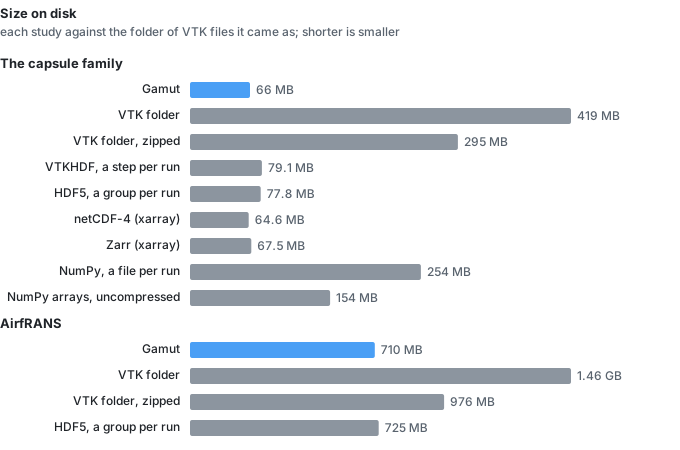
Size on disk
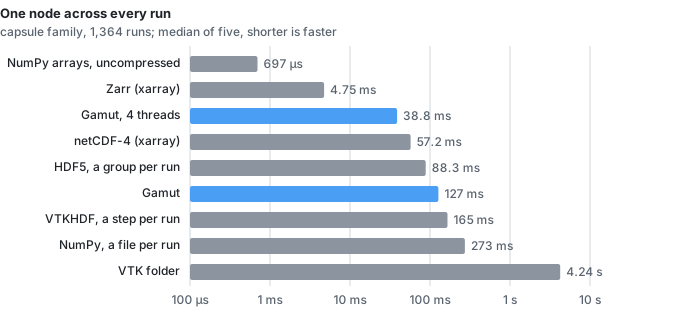
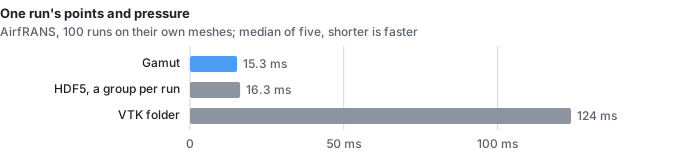
Reads
The capsule family
| Format | Size | Write | Open | One run | One node, every run | A region, every run | Runs by condition |
|---|---|---|---|---|---|---|---|
| Gamut | 66 MB | 1.19 s | 894 µs | 1.26 ms | 127 ms | 128 ms | 1.15 ms |
| Gamut, 4 threads | 66 MB | — | 896 µs | 1.26 ms | 38.8 ms | 40.3 ms | 1.18 ms |
| VTK folder | 419 MB | 10.7 s | 2.27 ms | 2.9 ms | 4.24 s | 3.89 s | 2.47 ms |
| VTK folder, zipped | 295 MB | 11.8 s | — | — | — | — | — |
| VTKHDF, a step per run | 79.1 MB | 1.32 s | 97 µs | 334 µs | 165 ms | 172 ms | 196 µs |
| HDF5, a group per run | 77.8 MB | 2.09 s | 293 µs | 279 µs | 88.3 ms | 93.7 ms | 74 ms |
| netCDF-4 (xarray) | 64.6 MB | 1.47 s | 5.61 ms | 58.1 ms | 57.2 ms | 78.9 ms | 5.95 ms |
| Zarr (xarray) | 67.5 MB | 179 ms | 2.41 ms | 5.01 ms | 4.75 ms | 5.61 ms | 3.82 ms |
| NumPy, a file per run | 254 MB | 6.92 s | 3.28 ms | 855 µs | 273 ms | 252 ms | 2.42 ms |
| NumPy arrays, uncompressed | 154 MB | 179 ms | 2.16 ms | 91 µs | 697 µs | 1.49 ms | 2.24 ms |
| Parquet, run table only | 0.14 MB | 447 ms | — | — | — | — | 1.32 ms |
AirfRANS
| Format | Size | Write | Open | One run | Runs by condition |
|---|---|---|---|---|---|
| VTK folder | 1.46 GB | — | 330 µs | 124 ms | 420 µs |
| VTK folder, zipped | 976 MB | 42.4 s | — | — | — |
| Gamut | 710 MB | 55 s | 703 µs | 15.3 ms | 728 µs |
| HDF5, a group per run | 725 MB | 31.3 s | 84 µs | 16.3 ms | 2.99 ms |
How it was measured
Formats
Gamut; the folder of VTK files the runs came as (written by PyVista with
its defaults for the capsule family, the published files for AirfRANS)
with a parameters.csv of the run table; that folder zipped; HDF5 written
with h5py, a group per run with each field a dataset compressed as Gamut's
are (shuffle, then gzip) and the run's parameters as attributes; netCDF-4
and Zarr written by xarray with their default chunking and compression
(shuffle and zlib for netCDF, zstd for Zarr); and the run table alone as
Parquet. Gamut uses gzip level 1, the HDF5 and netCDF copies level 4.
netCDF and Zarr have no standard layout for a set of different meshes, so
they appear for the capsule family only. The AirfRANS files carry three
integer id arrays that the Gamut and HDF5 copies leave out.
For the capsule family there are three more. VTKHDF 2.2 holds the study
as an unstructured grid with one time step per run: each shape's points
stored once, each field chunked a step at a time and compressed as the
HDF5 copy is, and the run table's number columns as field data; VTK's own
reader opens it, and the benchmark reads it with h5py. A compressed NumPy
file per run (numpy.savez_compressed) and one uncompressed .npy array
per field, read memory-mapped, each come with a parameters.csv. The
NumPy copies hold the fields, the points and the run table, but not the
cells. CGNS is not measured: it has no Python writer that installs without
building its library.
Reads
Open opens the study and lists what it holds. One run reads one run's pressure (with its points, for AirfRANS). One node, every run and a region, every run read the pressure at one node, or at 672 consecutive nodes, in all 1,364 runs. Runs by condition chooses the runs with Mach number above 20 and positive angle of attack (inflow speed above 50 m/s and angle above 5°, for AirfRANS) and reads a result of each.
Timing
Each format is measured in a fresh process, so no library's cache serves another. Each read opens and closes the file, as a script does. Times are the median of five, after one untimed read. The files are in the operating system's cache (clearing it needs administrator rights), so the times measure decoding and library work rather than the disk. Writes are timed once, from arrays in memory (the capsule family) or from the published VTK files (AirfRANS, where every format reads them). From one run of the whole benchmark to the next, medians moved by up to a third. During the capsule run another process used one of the machine's eight cores part of the time. Against an earlier run without it, every read's median was within 17 %, faster or slower, except Parquet's (893 µs then, 1.32 ms now).
For every read, every format returns the same numbers.
Machine
Apple M3, 8 GB, macOS-27.0.1-arm64-arm-64bit; Python 3.11.11; gamut 1.0.0.dev0, numpy 2.4.6, h5py 3.16.0, netCDF4 1.7.5, xarray 2026.9.0, zarr 3.1.6, pyarrow 26.0.0, pandas 3.0.6, pyvista 0.49.1, vtk 9.7.1; Gamut built from 0893621.
The scripts are in bench/, the results beside them in
bench/results/, and this page's tables and figures are generated from
those results by bench/figures.py.